The Story of Masha Stolnikewitz Altschuler
I am a Holocaust survivor, and my name is now Masha Altschuler. I live in Bnei Brak, at 51 HaRav Kook St., Tel. 03-6189750. I am the daughter of Chaya Sarah Stolnikewitz, nee Kalinska . My father's name was Mates. We were four kids at home, 2 girls and two boys. My youngest brother was born at the onset of the War. I had a brother who was two years older than me, called Socher Baya, a younger sister called Rochale, and the youngest brother was named Leizer, who was born when I was 11 years-old as aforesaid, at the outbreak of the War.
When the War broke out my place of residence was converted into the Ghetto. Everyone had to go out to work, even the children.
| click to enlarge |
|
 |
 |
Mother - Chaya Sarah Stolnikewitz, nee Kalinska (standing on the right) & sisters |
Mother - Chaya Sarah Stolnikewitz, nee Kalinska |
|
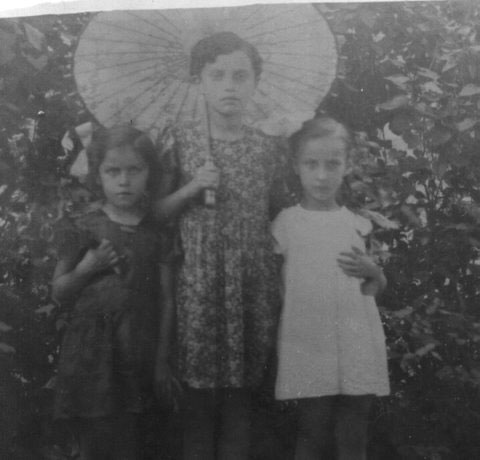
Masha as a child with her sister & a relative |
I was sent to work at Schtoier Resort – a shoe factory that manufactured footwear for the Germans, which we made from stalks, by braiding them and then sowing them together to make shoes. My mother, my father and brother were all employed at the Holts-galantery (a factory for wood products). At some stage I was relocated to the Schneider Resort, at Gavnizka Street, where we made uniforms for the German soldiers.
In 1942 a siren was sounded, which meant that everybody was to report bellow, at which time the children were taken out of the Ghetto. My younger brother and sister were transferred to Auschwitz (my older brother and me were also taken but my mother had managed to free us). Since then, we stayed and worked in the Ghetto, though later, when the ghetto was being abolished, they began searching for me as I was in the factory. We were not told that the Ghetto is being abolished, but rather that the factory is relocating. My mother no-longer believed them, and said that she was not willing to give up anymore of her children, and so we began hiding – every day at a different location. I was usually in a basement whose entrance was underneath a table, with a carpet concealing it. Though later, when we were informed that, if the person is not found the entire family will be taken, the whole family would hide, each time in a different place. Gradually, almost all of the people were transferred from the Ghetto. We ultimately hid under the roof – between the tiles, which is where we were caught. My cousin, who was named Esther Kalinska was with me at the time. We were all dispatched to Auschwitz.
| click to enlarge |
|
 |
 |
Masha & Benny in hospital in Landsberg |
Brother -Benny Stolnikewitz in Landsberg |
|
Masha & Benny with cousin Esther & her husband Yossef Kalinski |
When arriving to Auschwitz, the men and women were separated. My dad went along with my brother, while my mother, my cousin and I were separated into the women's side. At this time, my mother was also taken to the other side - for extermination. I remained with my cousin in Auschwitz for two weeks, following which we were transferred to the Bomlitz Labor Camp, where I stayed for 8 months. From Bomlitz, we were sent to Bergen-Belsen, and we also stayed there for two weeks to a month. From Bergen-Belsen we were transferred to the Helsnik munitions factory, where I stayed for 9 months of intensely hard labor.
One day, Lagerfuhrer - (commander of the camp at Elsnig Amunitions) had placed us in a boxcar in which we stood for an entire week. This was the end of the War, and there was nowhere left to send us to. We simply traveled back and forth for a week, until the 20th of April, when we were bombed. This was Hitler's birthday. The wagons had dismantled by the blasts. There were approx 10 wagons. Some had died and some were injured. We had dispersed from wagons. The area was full of holes from the bombardments, and the Germans who were guarding us had also fled and didn’t know what to do or in which direction to go. Anyone who was not injured or dead and was able to stand up on his feet also ran to the nearby forest, to seek food and shelter. As both my cousin and I suffered minor injuries, we were able to flee to the forest together with another group, were we foraged for food and water. We had wandered in the forest for a week or so, days when we did not know who we are and what we are. We were guarded by the Folk-de-Viechen, a group of armed people, such as soldiers and partisans who deserted the Russian or American armies, who had taken us with them. We went to wherever they went.
During nighttime we were put in stables, where we crowdedly slept in urine, and in the morning we moved on. We were approx 20-25 girls. I was released nearby the City of Branberburg. On the last day of the War, we suddenly realized that no one was guarding us anymore. We were closed in a building for a few days until we understood that there is no one there. We did not even dare to peep outside, and only after several days someone dared to take a look, to discover that there isn’t a soul in sight. We didn’t know that the War was over, though we noticed that the Russian army was already there. They gave us some food and one of the soldiers provided us with a wagon and some horses, and told us to ride in a certain direction. We rode for many days, and saw many dead people and horses along the way. We were searching for the way back home, as mum had told me that anyone who stays alive will return to Lodz.
At some stage I remained with my cousin without the wagon and we searched for any way to get back home. My cousin became ill and I had to carry her on the roads, which was very hard for me. We made part of the journey by foot, part by horse and wagon of a polish man who pitied us and took my cousin with him, and some on a train wagon. The journey was very hard and two weeks later we had arrived to Lodz, where I found no house and no family – nobody. We sat down and cried, and we did not know what to do. One lady who knew our family had passed by. She was among the people who stayed in the Ghetto (approx 650 people stayed in the Ghetto), and she took us to her home. My cousin began working at the butcher shop and I worked in a grocery store of someone who knew my mum.
Meanwhile, my brother had been informed that I am alive. He was in Kaufering death camp, from where he was sent to Landsberg, a camp which was converted, following emancipation, into a camp for Holocaust survivors (an American camp). He was there informed that I was alive and he came to Lodz and took me with him to Landsberg. My brother told me that, after we were separated, my father and he were transferred to a work camp in Kaufering (Dachau). I was told that my father was executed there as he was not feeling well. My brother spent the entire War in Kauprin, where he worked in munitions.
| click to enlarge |
|
|
 |
 |
 |
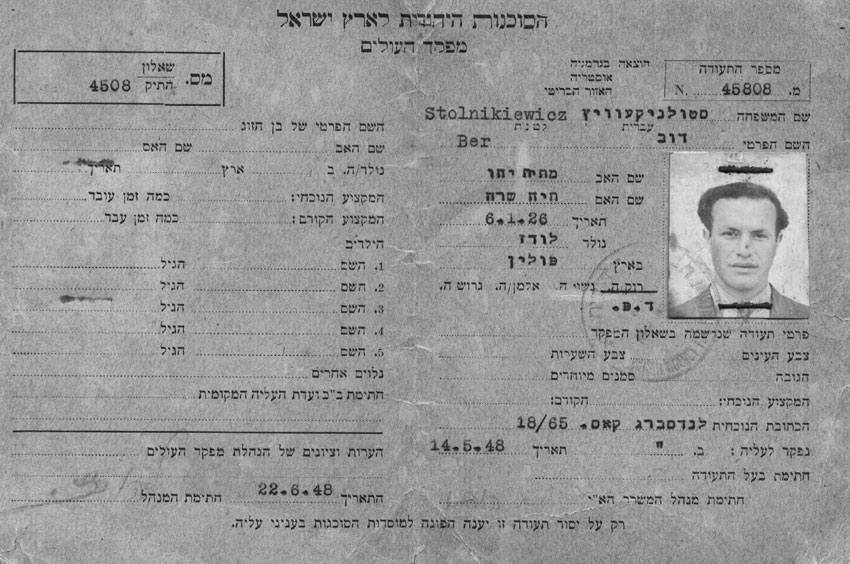
backside of Benny's Jewish Agency card |
Jewish Agency card: -Benny Stolnikewitz |
Benny Stolnikewitz |
I stayed one year in Landezberg, where I studied sowing at "Ort". On the 15th of May 1948 I had made aliyah to Israel. My brother stayed in Landezberg and ultimately arrived to Israel in 1949. I was married in 1950 and bore a child named Sarah Rosenblum, the surname is that of her husband. Six years later I had divorced and remarried, following which I bore a child named Haim Gil-Ad.
My brother had joined the army, though he had become ill. The Israeli sun was too harsh for him, so he left to Canada, where he lived until his death from cancer. He had married Hannah and they had two children, Natalie and Mark, who live in Canada. His name in Canada is Benny Stolenik.
I have since then been living in Israel. I have 5 grandchildren: 2 grandchildren from my son Haim and 3 from my daughter Sarah. I am currently expecting my first great grandchild.
My life was by no means easy, but I am proud of the fact that after all that I've been through, I was able to bring forth a new generation, which gives me so much pleasure and satisfaction.
I am very proud of having survived.
|