Biography of David Friedmann
(1893-1980)
Dav. Friedman(n) a.k.a. David Friedmann was born in 1893 in Mährisch Ostrau, Austria, now Ostrava, Czech Republic. He ventured from this industrial city to Berlin in 1911. He learned the techniques of copper etching and lithography from Hermann Struck and was awarded a scholarship to study art with Lovis Corinth. With the onset of World War I, Friedmann volunteered for the Austro-Hungarian Army, serving between 1917-1918 as an army artist. He was commissioned to draw battle scenes at the Russian Front and was decorated for producing sketches very close to the actual fighting. Thereafter, he sketched and painted portraits of generals and soldiers who had distinguished themselves in battle.
After returning to Berlin in the spring of 1919, Friedmann presented his first exhibition at the Akademie der Künste, on Pariser Platz, and published some of his works in the Jewish journal "Schlemiel." He gained recognition for his artistic work published in various newspapers, as well as exhibitions in the Berliner Secession and numerous galleries throughout Germany. His specialty was portraits drawn from real life. Besides politicians and dignitaries, he also produced portraits of famous celebrities, opera singers, actors, musicians and sports stars, including Albert Einstein, Ramsey MacDonald, and Yehudi Menuhin. He is renowned for a series of lithographs, "Das Schachmeister Tournier in Mährisch Ostrau, Juli 1923" (The Chess Master Tourney) and "Köpfe berühmter Schachmeister" (Portraits of Famous Chess Masters). Four portfolios of "Köpfe berühmter Schachmeister" were found including No. 28 in the collections of the Koninklijke Bibliotheek, National Library of the Netherlands.
| |
 |
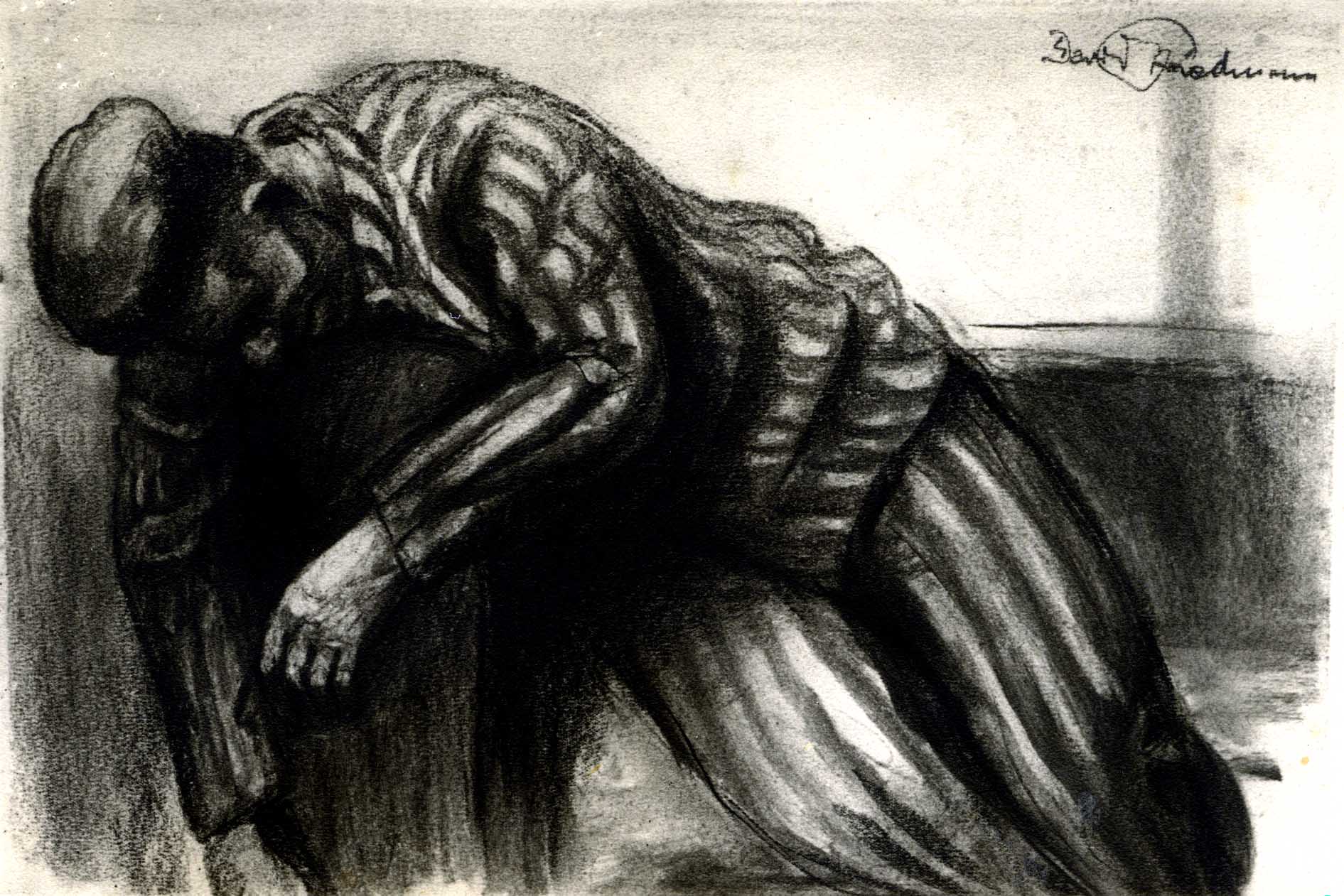
"Liberation?" (Charcoal, 1964)
A drawing from the series, "Because They Were Jews!"
Copyright © 1989 Miriam Friedmann Morris
All rights reserved
|
In December 1938, with his wife Mathilde and infant daughter Mirjam Helene, Friedmann fled to Prague, escaping from the Nazis with only his artistic talent as a means to survive. He introduced himself to the Jewish community hoping to interest them in having their portraits sketched for his album and perhaps a book. He produced many portraits of prominent Jews and personalities, including František Weidmann, Jakob Edelstein, Fredy Hirsch, and František Zelenka. Some of these photo reproductions miraculously survived; however, almost all his art produced until 1938 in Germany, and later in Prague until 1941, was confiscated by the Gestapo.
The Friedmann family was deported on October 16, 1941, on the first transport from Prague to the Lodz Ghetto in Poland. He sketched portraits of the leaders of the Ghetto in exchange for provisions; otherwise, they would have perished. The strength of Friedmann’s moral fiber can be judged by an incident that took place at “Metall II”, the factory where he worked. As witnessed by the young poet Avraham Cykiert, the foreman suggested that he design a triumphant Swastika Eagle hovering over broken flags of the occupied nations of Europe, "Deutschland, Deutschland ueber alles". The foreman was certain that for such a piece of art the group would surely receive a reward of additional food. In spite of the great hunger, he refused the commission and in a rage screamed at the foreman for making such a vile suggestion.
David, Mathilde, and Mirjam Helene Friedmann lived on
Bierstrasse 16 (Piwna ) in the Lodz Ghetto.
click to enlarge
From the series of artwork: "Because They Were Jews!"
Copyright © 1989 Miriam Friedmann Morris
All rights reserved
Note: No one other than Miriam Friedmann Morris may represent, edit or publish the art or material.
|
|
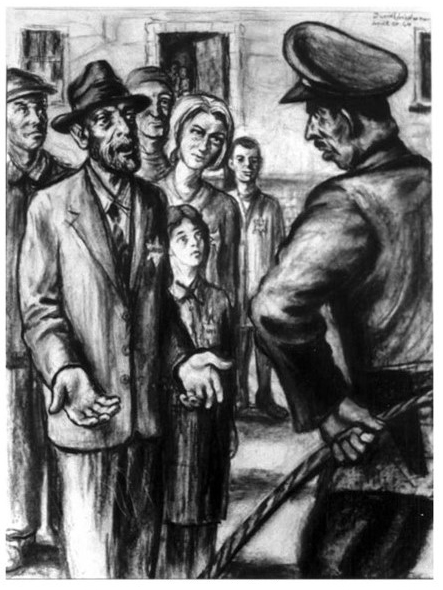
In the Lodz Ghetto
April 20, 1964. Charcoal, 24" x 18"
"You damned Jew," asked the Gestapo man, "where is all your money and jewelry?" "I gave up everything to others who came before you. Now I have nothing more," answered the Jew from Prague. "I do not believe you, damned Jew," the Gestapo man shouted excitedly and beat the Jew with his ox whip several times on his face and head.
. |
|
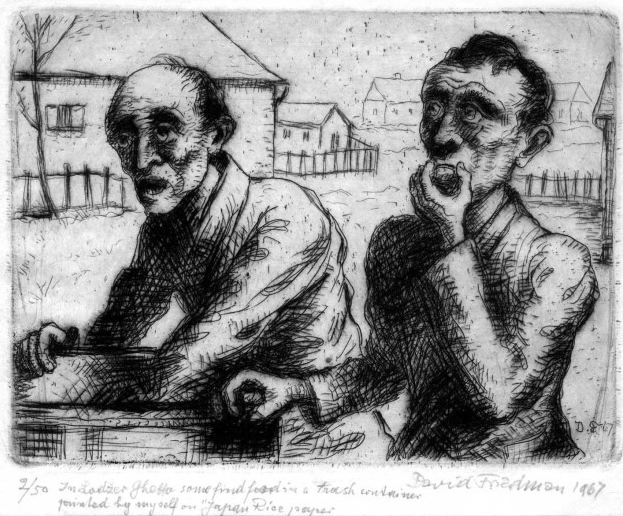
In Lodz Ghetto, Poland, Some Found Food In Trash Containers
1967. Original Etching printed by the artist, 5" x 7".
People are looking for food in backyards, but if you were caught, you were shot. I was able to observe with my binoculars taken with me from Prague. For a one-half pound of potato peelings, I had to pay $1.00 in fresh condition.
|
|
Through hunger and sickness, Friedmann kept a diary and painted scenes of his family and the infernal life in the Ghetto. His art, his diary, would be his testimony, but they were destroyed. When the Ghetto was evacuated at the end of August of 1944, Friedmann was separated from his wife and child, neither of whom survived the Holocaust. He was transported to concentration camps Auschwitz-Birkenau and Gleiwitz I, followed by a grueling death march to Blechhammer. Friedmann was liberated January 25, 1945 at the age of fifty-one years. He believed there was a reason for his survival - to show the world the persecution, torment, and agony as practiced by the Nazis, in the hope that such barbarism would never happen again.
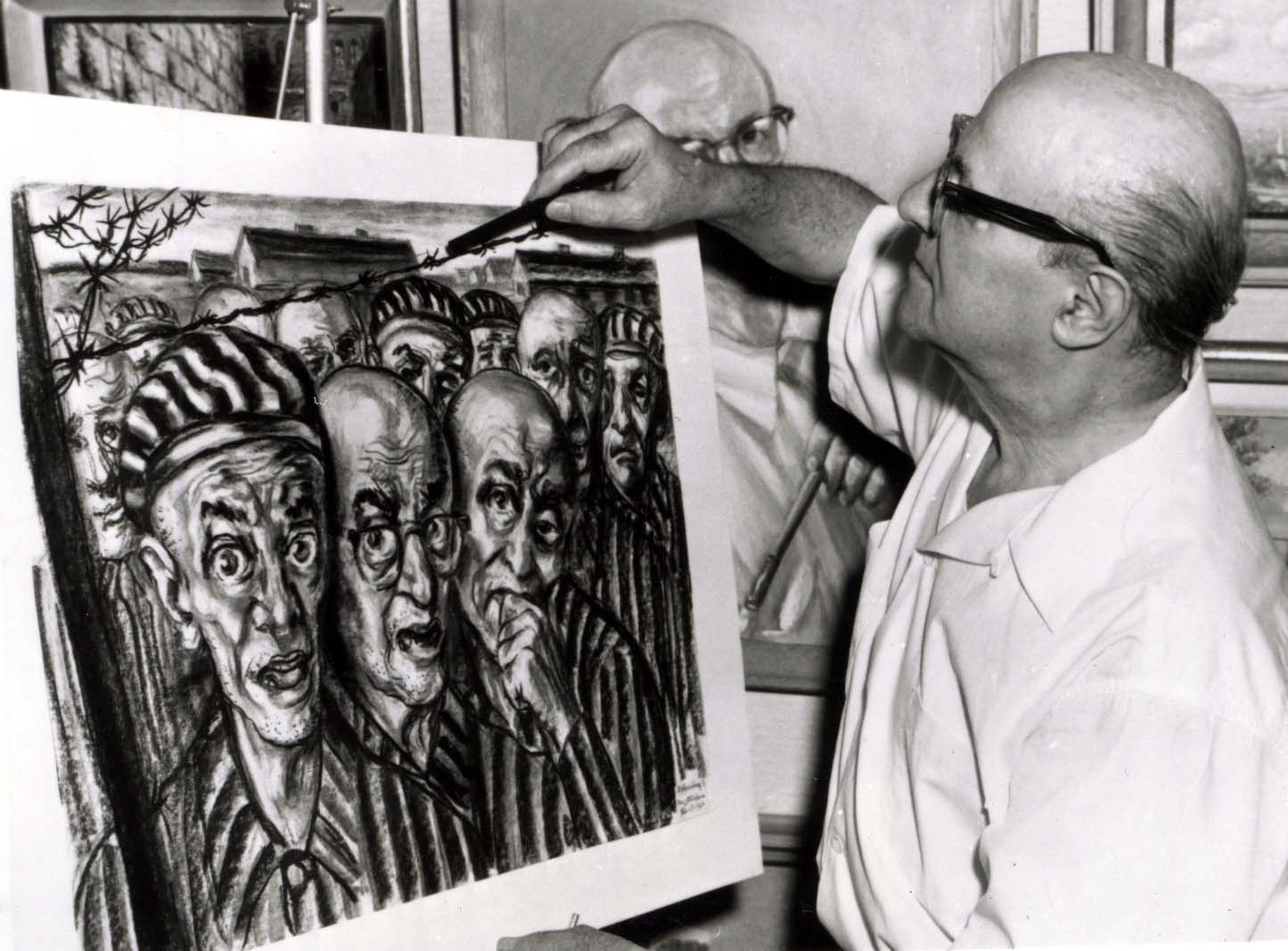
Determined to continue with his art, Friedmann began a new collection. He portrayed what he had witnessed and experienced, sometimes depicting himself as the prisoner with the glasses. He translated his haunting memories into over 100 individual works that show the evolution of the Holocaust from his deportation to the Lodz Ghetto and several concentration camps until his liberation. He supplemented his drawings and paintings with descriptions to create a singularly detailed pictorial and written record of the Holocaust. His attention to detail and keen observation was evident in this powerful series entitled, “Because They Were Jews!” - the first art collection to be accepted by the United States Holocaust Memorial Museum, Washington, DC. Seven of his first drawings produced in 1945 surfaced in the collections of the Yad Vashem Art Museum, Jerusalem, Israel. All works created during his incarceration were lost except for one portrait drawing found in the collections of the State Museum Auschwitz-Birkenau.
| |
|
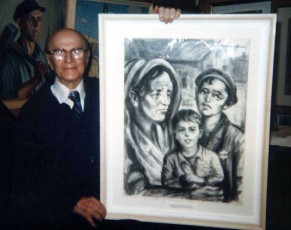
"Mother with Two Children in Lodz Ghetto (Litzmannstadt)"
1964. Charcoal, 24" x 18".
Collection of the United States Holocaust
Memorial Museum
Photo: David Friedmann, St. Louis, Missouri, 1976
|
Friedmann's ability to portray human documentaries is also evident in the series of thirty-four paintings and several drawings entitled, “Life of the Coalmine Workers of Habartov, Czechoslovakia , 1946-1947”. Interestingly, these works were created at around the same time as his Holocaust art, which toured several towns in the former Sudetenland. It was compulsory for all German nationals from the age of fifteen years to view this exhibition depicting the ghetto and concentration camps, before receiving their food ration cards. Although Friedmann believed that the Holocaust art was his most important work, the trip to the coalmining region offered him the necessary respite from the torment and agony of his memories.
David Friedmann married Hildegard Taussig in 1948, but instead of settling down in Czechoslovakia to enjoy their new life together, they fled to Israel in 1949. The Communist government had prohibited the Holocaust artwork from leaving Czechoslovakia. He successfully contrived a plan to get his works safely out of the country. In 1954, the Friedmann family, now including a daughter also named Miriam, immigrated to the United States. To support his family, Friedmann embarked on a new career in commercial art with General Outdoor Advertising Company. GOA transferred the family from New York City to Chicago, and finally to the St. Louis branch of the company. In 1960, the Friedmann family became United States citizens and dropped the double “n” spelling in their name.
| click to enlarge |
|
 |
 |
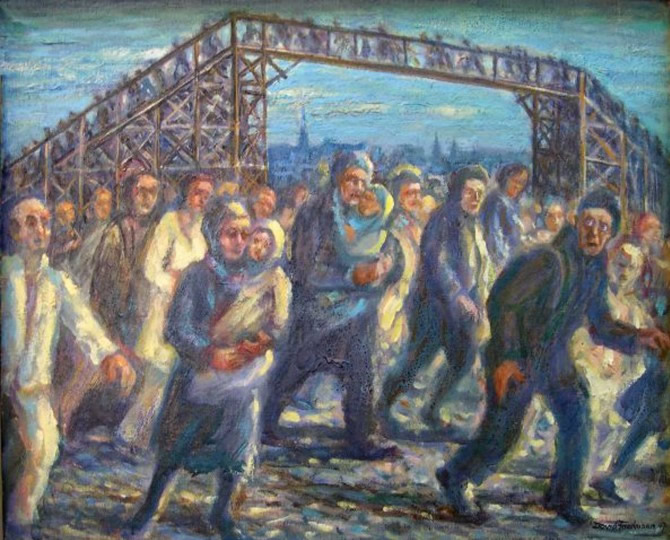
By day or night, the notorious "SS Rollkommando" suddenly
came to the Lodz Ghetto.
1947. Oil on canvas, 17" x 21". |
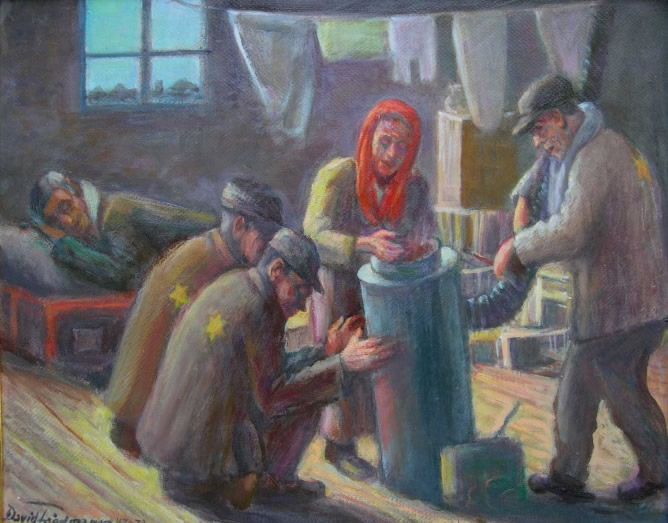
A Little Happiness Around the Oven during a Sad
Time in Lodz Ghetto
1947 - 73. Oil on masonite, 16" x 20". |
During his lifetime Friedmann produced a large body of work including various still life and genre themes, portraits, landscapes, and abstract art. He also created a unique exhibition entitled, “Enjoyment in Libraries with the Candid Pencil of David Friedman.” This series, about 100 drawings, consists of life studies of people in various St. Louis libraries between 1962-1972. The portraits capture the essence of the unsuspecting public’s enjoyment of the library and were exhibited in various libraries in St. Louis, Missouri and Rockland County, New York. Friedmann also enjoyed portraying himself and his wife "Hilde" through sketches, drawings and oil paintings from 1946 until a year before he died in 1980, at the age of eighty-six, in St. Louis, Missouri.
| click to enlarge |
|
 |
 |
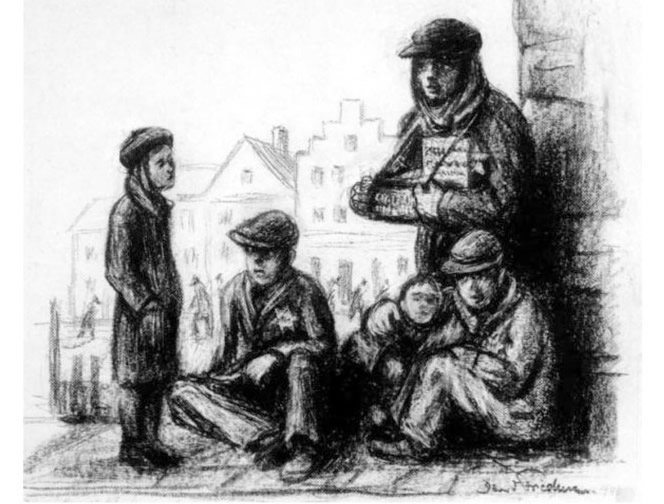
Children Selling Cigarettes and Self-made Candy in the Streets
of Lodz Ghetto, 1941-1944
1948. Lithographic crayon, 9" x 11". |
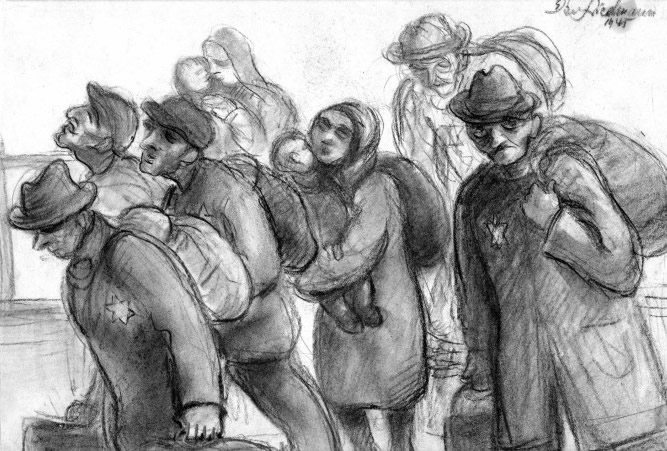
On the Way to a Concentration Camp
1945. Charcoal, 8" x 11". |
The year 2003 proved to be significant in the continuing history of David Friedmann. Several works, including a preliminary drawing of František Weidmann, were located in the holdings of the Jewish Museum Prague. Numerous examples of his stolen prewar artworks were posted on the “Lost Art Internet Database” at www.lostart.de . This represents only a small quantity of the over two thousand works plundered under the Nazi Regime. The year ended with excerpts published from his diary written after liberation in 1945, "Dachauer Hefte 19. Zwischen Befreiung und Verdrängung". They were published as "David Friedmann: Nach der Befreiung. Tagebuchnotizen auf dem Weg von Krakau nach Prag" [After the Liberation. Diary notes on the way from Krakau to Prague] on behalf of the "Comite International de Dachau, Brüssel.
David Friedmann is a distinguished artist, having achieved acclaim and a great reputation as a painter known for his portraits. During the course of his life, he fought for his existence and with his wits, quick sketching, and painting talents survived the Holocaust. He was recognized as an outstanding illustrator as well as for his drawings, paintings, graphics, etching, lithography, and work in the advertising industries. However, his greatest contribution was his devoted commitment to produce an eyewitness testament dedicated to the six million Jewish victims of Nazi persecution.
More about David Friedmann and his art at:
The daughter Miriam Friedman Morris - is searching for her father's lost art - yes even in Israel:
http://www.chgs.umn.edu/museum/responses/friedmann/lostArt.html
There is a lost drawing brought to Eretz Israel in 1947 by Zeev Shek. His widow told Miriam Friedman Morris - she donated the drawing to Yad Vashem - but Yad Vashem says the drawing was not received. They cannot find it among their collection:
| |
|
Concentration Camp Prisoner
1945. Charcoal. Last seen in Israel, the location of this drawing is unknown.
The artist's daughter is
searching for the original work which is believed to be in Israel.
|
Contributed by his daughter, Miriam Friedman Morris .
Miriam Friedman Morris wrote on Pessach 2012:
I am excited to share this film about the exhibition just posted last week on YouTube by Deutsches Haus NYU:
http://www.youtube.com/watch?v=kQFh748qS5Y&list=UUS3lcih4m98vNAV20LG99xw&index=1&feature=plcp
To recapture the past that would have been lost forever is a gift to the world. |